


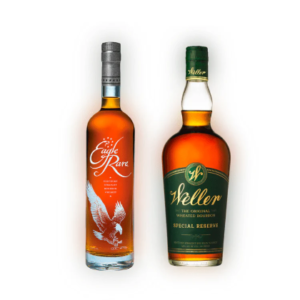
Eagle Rare 10 Year & Weller Special Reserve Bundle
$114.00
| Country | America |
|---|---|
| Brand | Buffalo Trace |
| Flavour Profile | Virgin Oak Cask |
This bundle pairs Eagle Rare 10 Year and Weller Special Reserve — two of the most sought-after allocated bourbons from Buffalo Trace Distillery representing two distinct mashbills: the high-rye single barrel and the wheated entry expression.
Both bottles come from Buffalo Trace in Frankfort, Kentucky, but use fundamentally different recipes. Eagle Rare 10 Year is a single barrel aged a minimum of ten years using the standard Buffalo Trace mashbill — drier, more complex, with leather and oak from the extended aging. Weller Special Reserve uses the wheated mashbill — the same recipe as the Pappy Van Winkle family — for a softer, more approachable character at 90 proof. Side by side they illustrate the mashbill difference more clearly than almost any other two-bottle pairing from the same distillery.
What’s Included
Eagle Rare 10 Year 750ml — Single barrel, minimum 10 years, 90 proof. Toffee, orange peel, herbs, honey, leather, and oak; dry flavors with candied almonds and rich cocoa; long dry finish.
Weller Special Reserve 750ml — Wheated Kentucky straight bourbon, 90 proof. The original wheated mashbill — soft caramel, honey, and butterscotch with gentle oak. The green label Weller.
All bottles ship together. Browse the full Buffalo Trace collection at Wooden Cork.
Frequently Asked Questions
What is the mashbill difference between Eagle Rare and Weller Special Reserve?
Eagle Rare uses the standard Buffalo Trace mashbill — corn, rye, and malted barley — producing a drier, spicier profile at 90 proof with 10+ years of aging. Weller Special Reserve uses the wheated mashbill — corn, wheat, and malted barley — producing a softer, sweeter profile at 90 proof with no age statement. Same distillery, same proof, two very different characters.
Which is harder to find — Eagle Rare or Weller Special Reserve?
Both are allocated by Buffalo Trace and sell out quickly at primary retail. Eagle Rare 10 Year is produced in smaller quantities as a single barrel expression with a minimum 10-year aging commitment. Weller Special Reserve receives broader distribution than other Weller expressions but still requires allocation access. Both are available together here when stock permits.
Related products
-
Bourbon Whiskey
Glenlossie 1993 Aged 31 Years Speyside Single Malt Scotch Whisky – Càrn Mòr Celebration Of The Cask (700ml)
Original price was: $260.00.$230.00Current price is: $230.00. Add to basket -
Bourbon Whiskey
Glen Elgin 2007 UCF Aged 14 Years Single Malt Scotch Whisky – Signatory Vintage (700ml)
Original price was: $100.00.$70.00Current price is: $70.00. Add to basket -
Carn Mor Collection
Glenrothes 2011 Aged 9 Years Speyside Single Malt Scotch Whisky – Càrn Mòr Strictly Limited (700ml)
Original price was: $150.00.$120.00Current price is: $120.00. Add to basket -
Cask Strength
Caol Ila 2010 Aged 10 Years Single Malt Scotch Whisky – Signatory Vintage (700ml)
Original price was: $210.00.$180.00Current price is: $180.00. Add to basket


Reviews
There are no reviews yet.